
Abhayagiri Vihāra was a major monastery site of Mahayana, Theravada and Vajrayana
Buddhism that was situated in Anuradhapura, Sri Lanka. It is one of the most extensive ruins in
the world and one of the most sacred Buddhist pilgrimage cities in the nation. Historically it was
a great monastic centre as well as a royal capital, with magnificent monasteries rising to many
stories, roofed with gilt bronze or tiles of burnt clay glazed in brilliant colors. To the north of the
city, encircled by great walls and containing elaborate bathing ponds, carved balustrades and
moonstones, stood "Abhayagiri", one of seventeen such religious units in Anuradhapura and the
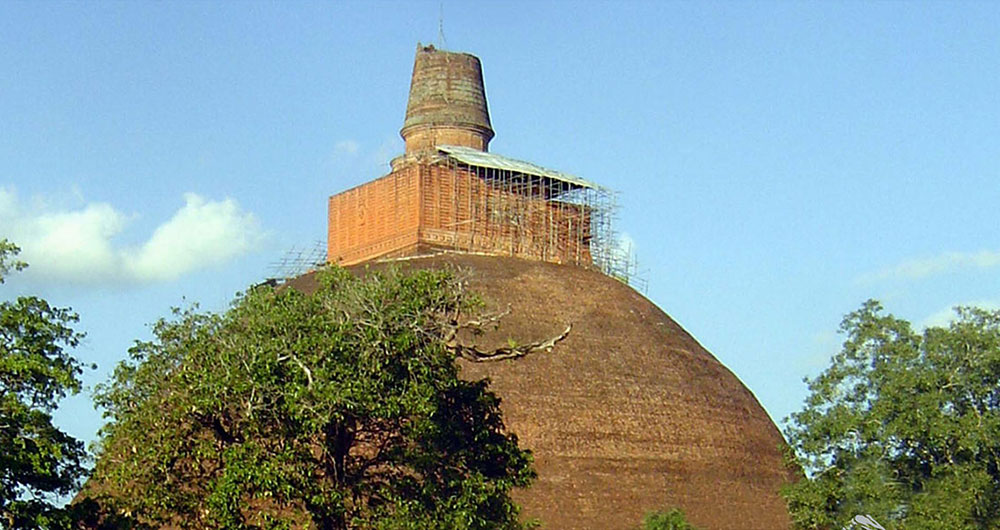
largest of its five major viharas. One of the focal points of the complex is an ancient stupa, the
The term "Abhayagiri Vihara" means not only a complex of monastic buildings, but also a
fraternity of Buddhist monks, which maintains its own historical records, traditions and way of
life. Founded in the 2nd century BC, it had grown into an international institution by the 1st
century AD, attracting scholars from all over the world and encompassing all shades of Buddhist
philosophy. Its influence can be traced to other parts of the world, through branches established
elsewhere. Thus, the Abhayagiri Vihara developed as a great institution for the monastic sects in
the ancient Sri Lankan capital of Anuradhapura.
The architectural elements of the buildings excavated at Abhayagiri Vihara clearly reflect the
social beliefs and religious practices prevalent at the time. Although Buddhism was the state
religion and the principal doctrine followed by the majority of the population, the influence of
other local beliefs, particularly Hinduism, were considerable, and are expressed in the
architecture of the period. The design of entrances, for example, illustrates the practice of placing
buildings under the protection of a guardian deity.
The two slabs erected on either side of the foot of the flight of steps leading to a building are
known as guard stones (Muragal). They are usually carved, although plain guard stones have also
been found. Among the Hindu symbols represented on these stones, the most common, apart
from the Pot of Abundance and Kalpavrksa, is the figure of the Nagaraja, or anthropomorphic
King Cobra. The best example of these, and one of the finest guardstones yet discovered, was
found at the Ratnaprasada in Abhayagiriya, and illustrates the degree of perfection reached by
the sculptors of Abhayagiri. Lotuses and punkalas are indicative of plenty. Representations of the
lotus are of particular significance in agricultural societies where they symbolize the daughters of
the guardian deity of rain. The elephant figure at the Eth Pokuna is also a symbol of water.
The principal Buddhist guardian deities are frequently indicated by the animal vehicles of the
particular gods, particularity on the guard stones. A good example is furnished by the exquisite
statues on either side of the entrance to Abhayagiri Stupa. The headdress of one of the statues is
a conch while that of the other is a lotus. Representing Sanka and Padma, the two principal
treasure houses of Kuvera, they are believed to have been erected to ward off any evil or danger
that might threaten the stupa or its precinct. Even at present they are commonly believed to be
endowed with mystic powers, and courts of law in Anuradhapura accept swearing before the
statues as evidence in settlement of minor disputes between litigants.
The best example of a moonstone, a unique creation of Sri Lanka sculptors, can be seen at the
foot of the steps leading to the Pancavasa commonly known as Mahasena’s palace. A smaller
example, just as exquisitely carved, was found nearby at the Queen's Pavilion. Varying in shape
and size and made of different kinds of stones, all are exquisite artistic creations. According to
Paranavitana, the moonstone symbolizes samsara, the endless cycle of rebirth, and the path to
freedom from the samsaric process leading to nirvana. He interprets the pattern of the outermost
ring as flames, and the various animals shown in the other concentric circles as successive phases
of man's passage through samsara.
Over the course of 15 years, the Abhayagiri Stupa was fully restored and renovated by the Sri
Lankan Central Cultural Fund as a UNESCO project.